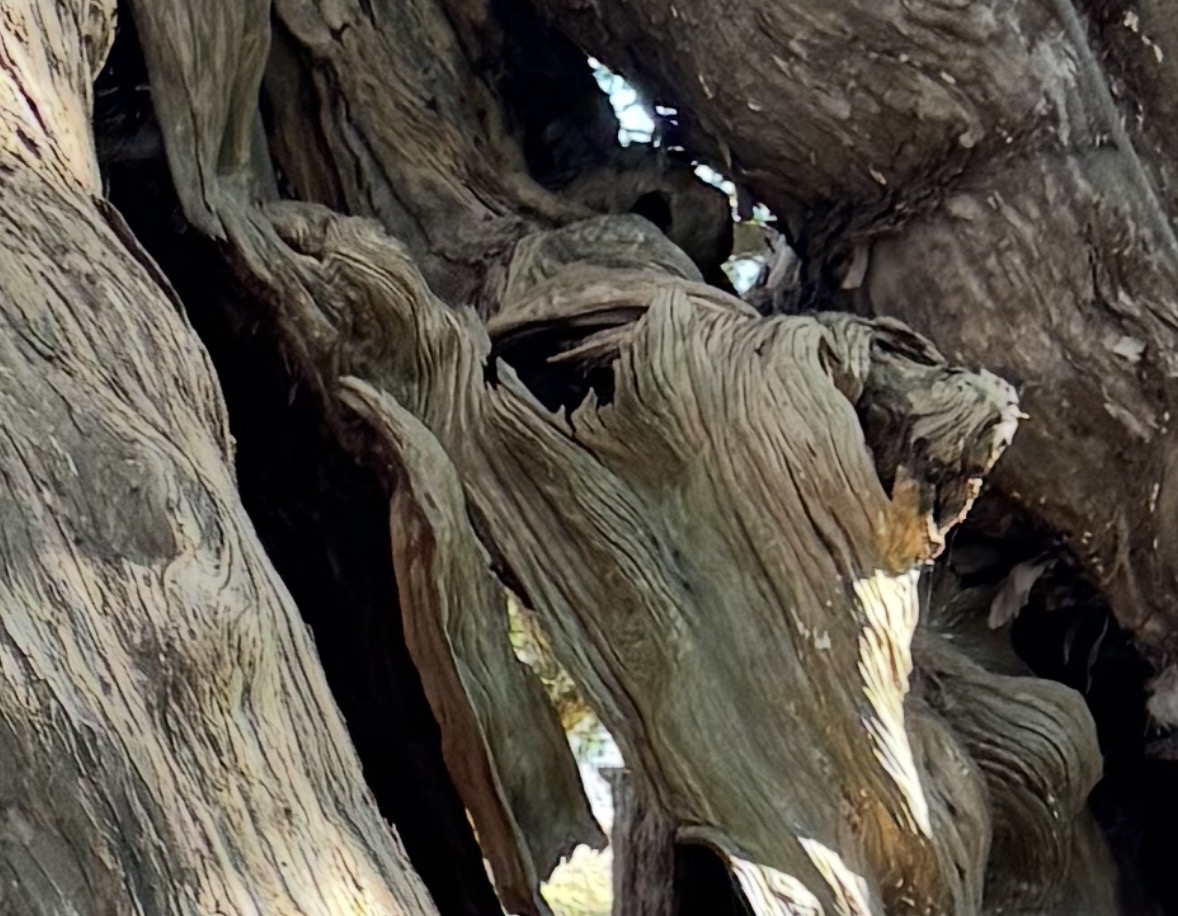
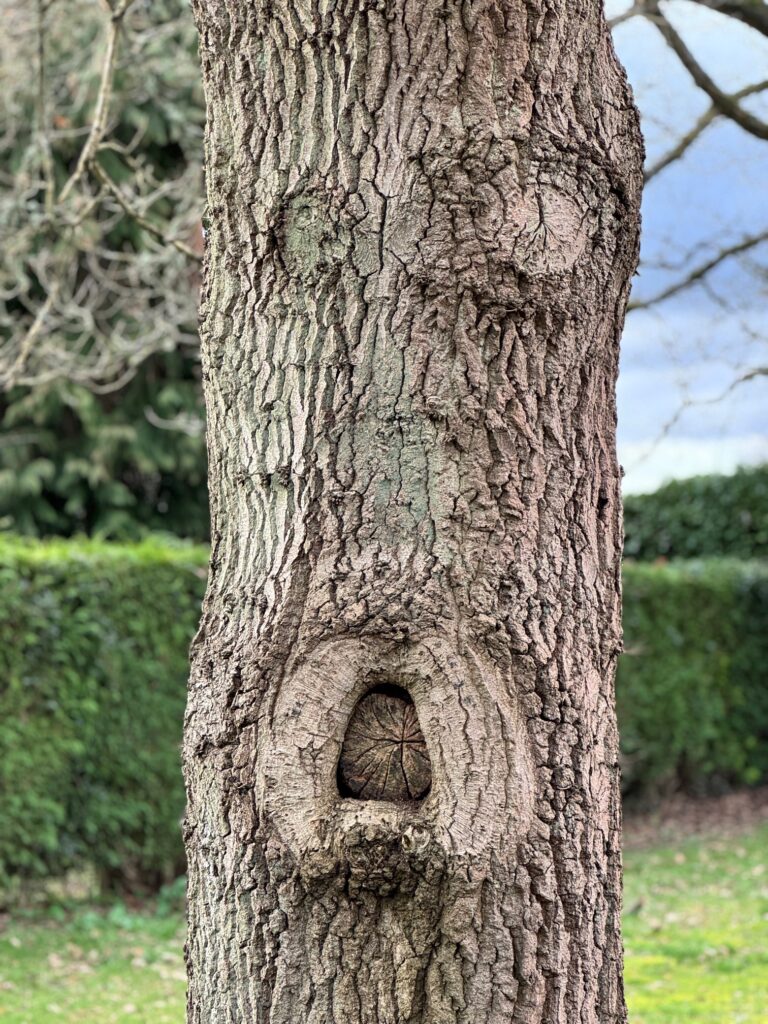
On a recent recce walk in the countryside around Crowhurst, I paused beside an old tree and suddenly noticed a face looking back at me.
Two knots for eyes. A long crack for a mouth. Once I saw it, I couldn’t unsee it.
As I walked further, more appeared. Some looked like people, others almost animal-like, an owl, a fox. In other places the bark held no faces at all, just deeply ridged, folded textures that only very old trees seem to have. I found myself standing there for a while, simply admiring the patterns and the quiet beauty of it.
There is a name for this: pareidolia, the mind’s natural tendency to recognise familiar patterns, especially faces, in random shapes. Our brains evolved to spot faces quickly, because recognising friend, foe, or a fellow human was essential for survival. Even today, this instinct remains strong, and sometimes our minds see faces where there are none.
Tree bark is perfect for this kind of seeing. Its scars, knots, and textures, especially on older trees, often form shapes our minds interpret as expressions. A hollow might become a mouth, a knot an eye, a ridge a brow. In a way, the tree becomes a canvas on which our minds can play, projecting personality and emotion onto the natural world.
But there is more to it than just a trick of perception. When we slow down in nature, our attention softens. We stop rushing, we become more observant, and our minds naturally begin to wander and imagine. Pareidolia encourages us to connect with the world in a more intimate way, noticing subtle details, sensing the presence of life around us, and even feeling empathy for the “characters” we discover in the landscape.
In these moments, the countryside begins to feel alive. The ordinary textures and shadows start to carry stories, personalities, and histories. Our senses awaken, our imagination blooms, and we experience a quiet connection that goes beyond just looking — we begin to see, feel, and relate to the natural world as if it were a living companion.
Perhaps that is part of the quiet invitation trees offer us.
Not just to observe them as objects in the landscape, but to meet them in a more imaginative, more relational way. To allow a knot to become an eye, a hollow to become a voice, and in doing so, to soften the boundary between ourselves and the natural world.
Whether these faces are simply patterns our minds are wired to find, or something more poetic and mysterious, they have a way of slowing us down. They ask us to linger. To look twice. To be present.
And maybe that is enough.
Because in a world that often pulls our attention elsewhere, these small moments of wonder bring us back, to the bark beneath our fingers and the quiet companionship of trees that have stood far longer than we have.
Next time you find yourself walking among them, pause for a moment.
You might just find that something is looking back.

