Spring Greens of the Surrey Hills
Each April, I step into the Surrey Hills with a quiet kind of gratitude. The land, which only weeks ago felt bare and sleeping, begins to soften and offer itself again. Greens return in layers, tender, bright, alive. Along the paths I know so well, there is food, medicine, and something less tangible but just as nourishing: a feeling of being in relationship. This spring, I had the joy of sharing that experience on a foraging walk that ended with a bespoke delicious foraged menu at The William IV in Shere, a simple reminder of how these plants move from landscape to table.
These plants are not separate from my life. They find their way into my kitchen, into my teas, into remedies shared with others. But more than that, they shape how I move through the seasons, slower, more attentive, more in conversation with what is growing around me.
If you have been foraging with me this spring, you will recognise most of the plants in this guide — old friends by now, perhaps, or at least familiar faces along the path. For those coming to this fresh, consider it an invitation to begin.
What follows is a guide to some of the spring greens emerging now, listed by families, which I find a useful way of understanding and remembering them. Not a clinical list, but an invitation to notice, to recognise, and to begin forming your own connection with them.
A note for those who are pregnant: some of the plants in this guide have traditional contraindications during pregnancy, particularly those with bitter, emmenagogue, or strongly medicinal properties. These are noted where relevant. As always, if you are pregnant or trying to conceive, it is worth checking with a qualified herbalist or your midwife before using any plant medicinally. Culinary amounts in food are generally considered safe.
Mustard Family (Brassicaceae)
A family of sharpness and brightness. Peppery leaves, small four-petalled flowers, a spark of life after winter.
Garlic Mustard
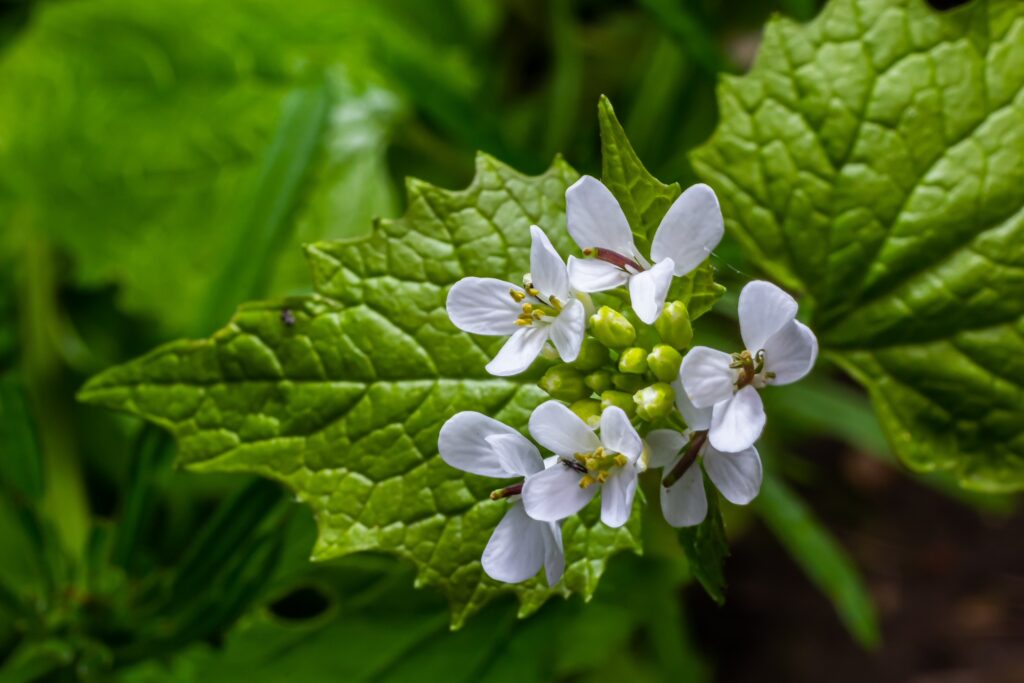
Identification: A biennial rhythm. First year, a low rosette of rounded, heart-shaped leaves close to the earth. Second year, it rises, leaves becoming more pointed, sending up delicate white flowers. Crush a leaf and the scent of garlic is unmistakable.
Habitat: Woodland edges, hedgerows
Uses: Leaves bring a gentle heat to pestos and salads. Flowers are edible too, scattered like small white offerings, adding both beauty and flavour
Forage: Young leaves in early spring, flowers in the second year
Folklore: A plant of vitality, of clearing and awakening
Carrot Family (Apiaceae)
A family that asks for respect. Umbels like open hands, offering nourishment or danger. Here, knowing is everything.
Hogweed
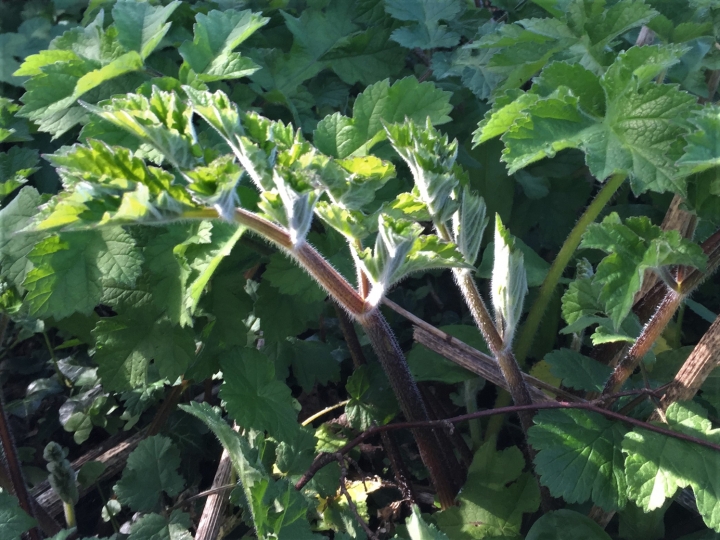
Identification: A tall, robust biennial or perennial that can reach well over a metre in height. The stems are hollow, ridged, and distinctly hairy, often painted with purple at the base. The leaves are large and broadly divided, rough and slightly hairy, with a coarse, almost cabbage-like texture. The flowers are carried in large, flat-topped umbels — the characteristic umbrella-shaped flower clusters of the carrot family — creamy white and abundant, attracting an enormous range of insects throughout summer.
A critical note on identification Hogweed must be distinguished carefully from its dangerous relative giant hogweed, Heracleum mantegazzianum, whose sap causes severe phototoxic burns on contact with skin in sunlight. Giant hogweed is significantly larger — sometimes reaching five metres or more — with a thicker, blotched purple (blood splatter) stem and much larger leaves and flower heads. Common hogweed is also sometimes confused with hemlock, which is highly toxic. Hemlock has smooth, purple-spotted (blood-splatter) stems without the coarse hair of hogweed, and a distinctly unpleasant musty smell when crushed. If you are in any doubt, do not harvest. This is a plant that rewards careful, confident identification before foraging.
Habitat: Meadows, verges, edges where wildness gathers
Uses: In early spring, the unopened leaves and tightly held flower buds (later in spring) are rich and comforting, sautéed simply in butter with salt and pepper. Later, the seeds dry to brown and carry a warm spice, reminiscent of cardamom
Forage: Young shoots, leaves, unopened flowers, and later the seeds
Important Note: Must not be confused with Giant Hogweed, which stands taller, is hairless, and has blood-splatter purple markings on the stem and can cause harm
Ground Elder
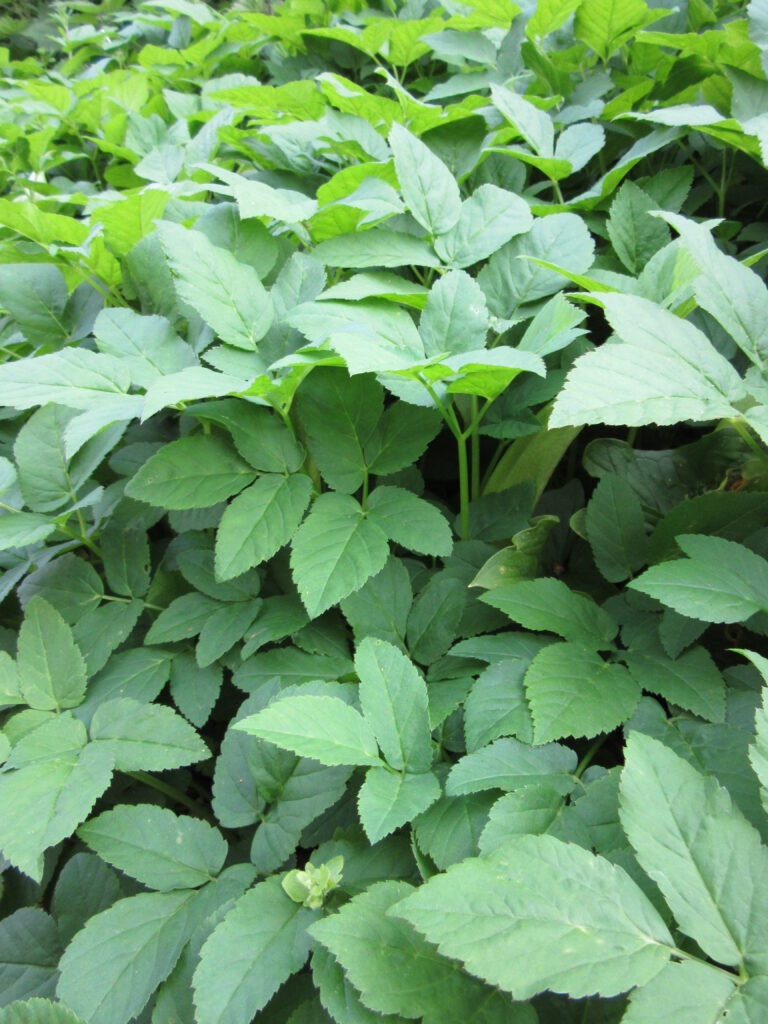
Identification: A low to medium-growing perennial that spreads vigorously by underground rhizome, forming dense carpets of foliage in shaded and semi-shaded ground. The leaves are divided into pointed, oval leaflets with toothed edges, carried on long, hollow, triangular stems — the triangular cross-section of the stem is one of the most reliable identifiers. The overall leaf shape is reminiscent of elder, which gives the plant its name, though the two are entirely unrelated. The flowers, appearing in early summer, are small and white, carried in flat-topped umbels in the characteristic style of the carrot family.
A note on confusion species As a member of the carrot family, ground elder must be identified with care and confidence before harvesting. The triangular hollow stem and the distinctive scent — fresh, green, and faintly anise-like when crushed — are the most reliable identifying features. Never harvest any umbellifer unless you are certain of its identity.
Habitat: Ground elder is a plant of shaded and semi-shaded ground — woodland edges, hedgerow bases, churchyards, and gardens, where it spreads with quiet persistence through its creeping rhizomes. It has a particular association with human habitation, introduced to Britain by the Romans as a food and medicinal plant and now naturalised across the country. It thrives wherever the soil is moist and fertile and the light is dappled, and once established is notoriously difficult to remove — a fact that any gardener who has encountered it will know well.
Uses: Bright and green in the kitchen, a wild parsley. A tea long used for easing gout
Forage: Young leaves before flowering
Folklore: Once tended in monastery gardens, valued and gathered
Hemlock Water Dropwort (Highly Poisonous – Do NOT Forage)
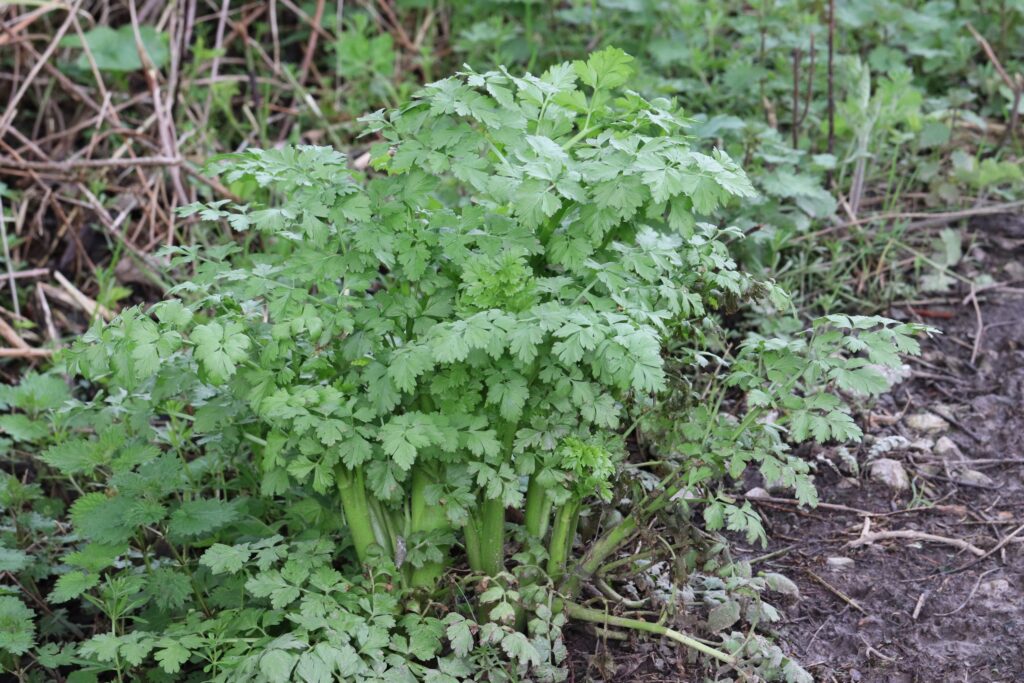
Identification: At first glance, something almost edible in appearance, celery-like. Smooth, hairless stems, sometimes streaked with purple. Dense white umbels. Always close to water
Habitat: Riverbanks, ditches, wet ground
Warning: This is one of the most dangerous plants in the land. Ingestion brings a tightening of the face into what is known as a sardonic grin, followed by seizures and a shutting down of breath. It acts quickly, sometimes within minutes to a few hours
Folklore: A plant of warning. One that reminds us to move slowly and with care
Hemlock (Highly Poisonous – Do NOT Forage)
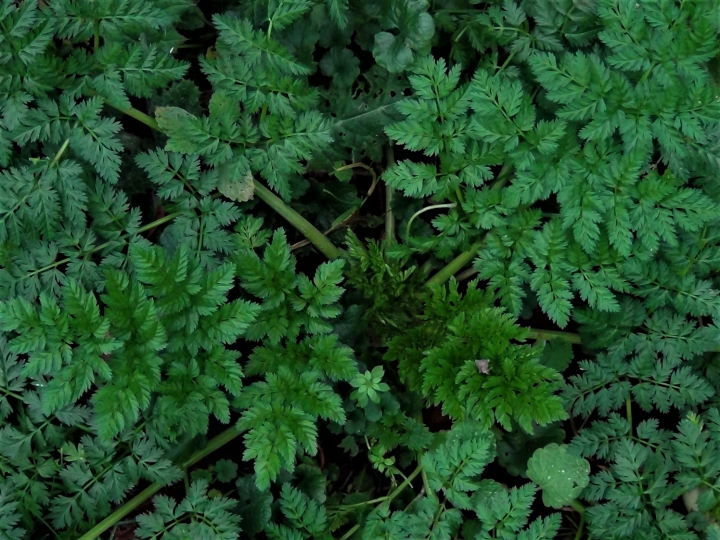
Identification: Tall and elegant, easily mistaken for cow parsley at a distance. The stem tells the truth, smooth and hairless, marked with deep purple blotches like spilled ink (blood splatter).
Habitat: Roadsides, hedgerows, disturbed soils
Warning: Highly toxic. Not a plant to forage. This is the plant historically associated with the death of Socrates, who was sentenced and chose to drink a hemlock preparation. His final moments were recorded, describing a gradual paralysis moving up the body until breathing ceased
Folklore: Long associated with poison and endings
Mint Family (Lamiaceae)
Squares and pairs. Square stems, leaves in opposite pairs. Aromatic, familiar, often generous in their medicine.
Ground Ivy
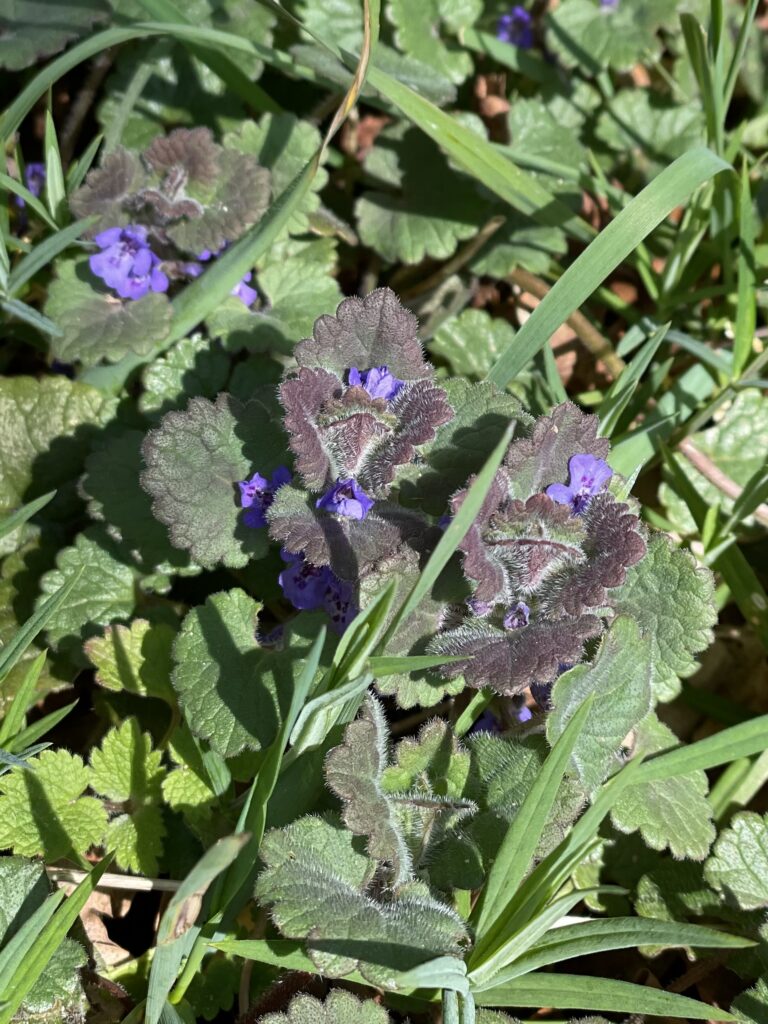
Identification: Low-growing, creeping, with softly scalloped leaves. The scent rises somewhere between rosemary and sage when touched
Habitat: Lawns, woodland edges, places where footpaths soften
Uses: A gentle tea for the lungs. Or a simple tonic, leaves chopped and left to infuse in cool water overnight, then strained and sipped through the day. The tonic has a fresh taste, almost like mint water.
Pregnancy: Avoid in medicinal quantities during pregnancy. Has mild emmenagogue properties and is traditionally cautioned against during pregnancy, though small culinary amounts are generally considered safe.
Forage: Leaves before flowering
Folklore: Once brewed into ale, said to bring clarity to the mind
White Dead Nettle
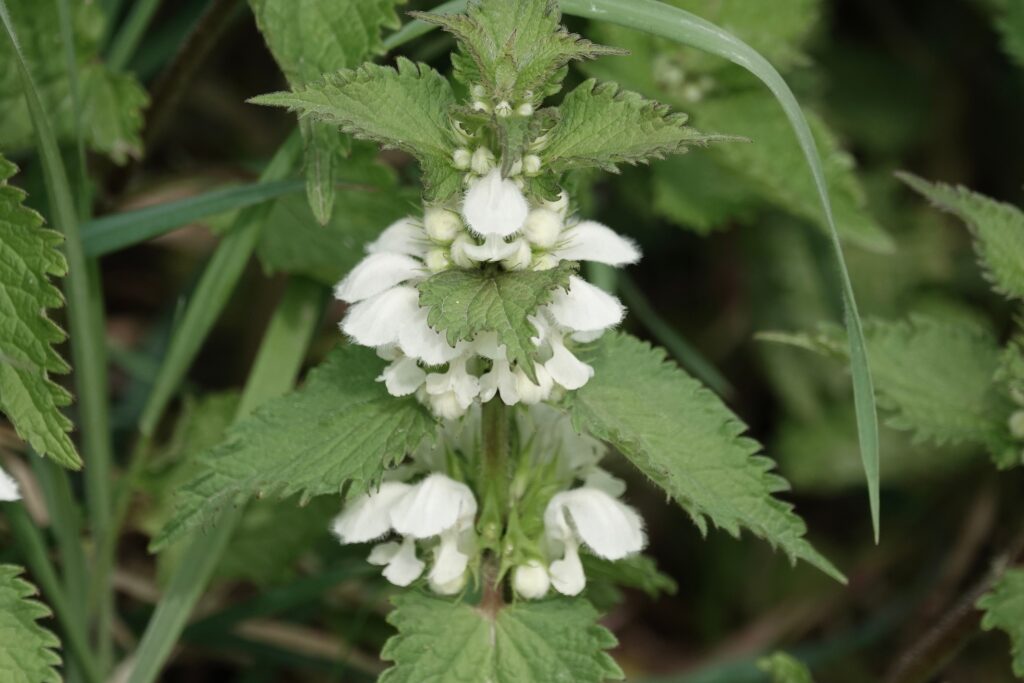
Identification: Soft leaves, familiar in shape to nettle but without the sting. White flowers tucked beneath the leaves
Habitat: Shaded hedgerows
Uses: A nourishing tea, traditionally used to support the body through the menstrual cycle and ease discomfort
Forage: Leaves and flowers
Folklore: Gentle and protective
Purple Dead Nettle
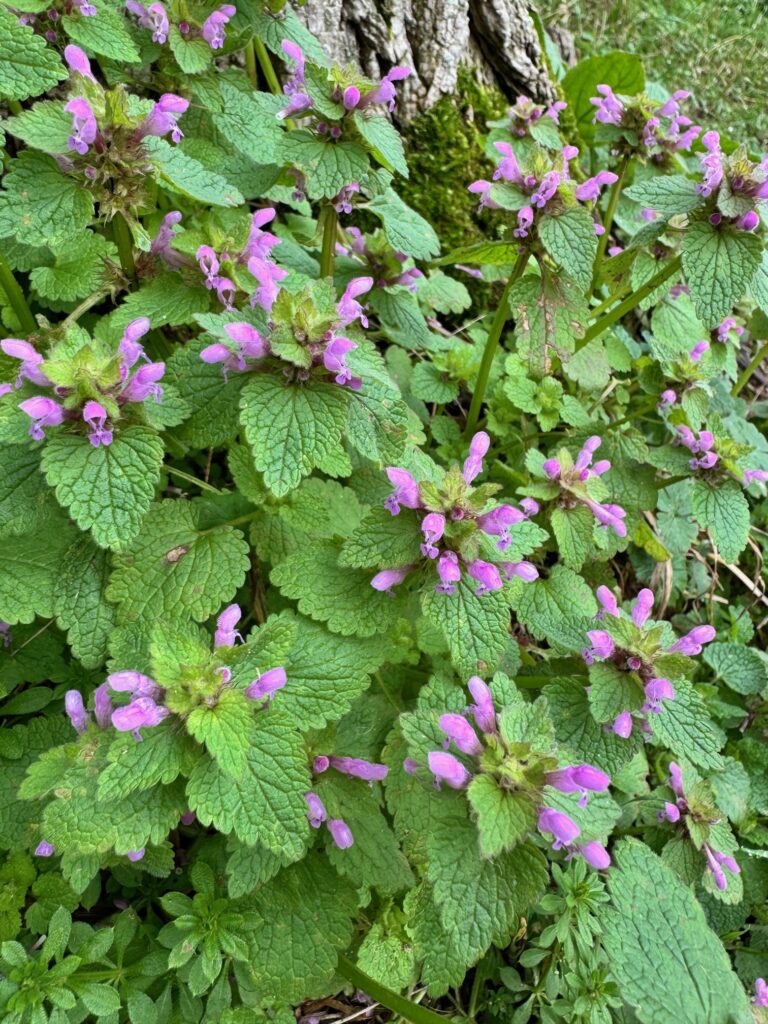
Identification: Square stems, soft leaves flushed with purple at the top, small pink-purple flowers
Habitat: Gardens, disturbed soils
Uses: Nutritive and grounding, often taken as a tea
Forage: Whole young plant
Folklore: A sign of early spring vitality
Rose Family (Rosaceae)
A family of nourishment. Thorn and softness together. Flowers that become fruit.
Bramble
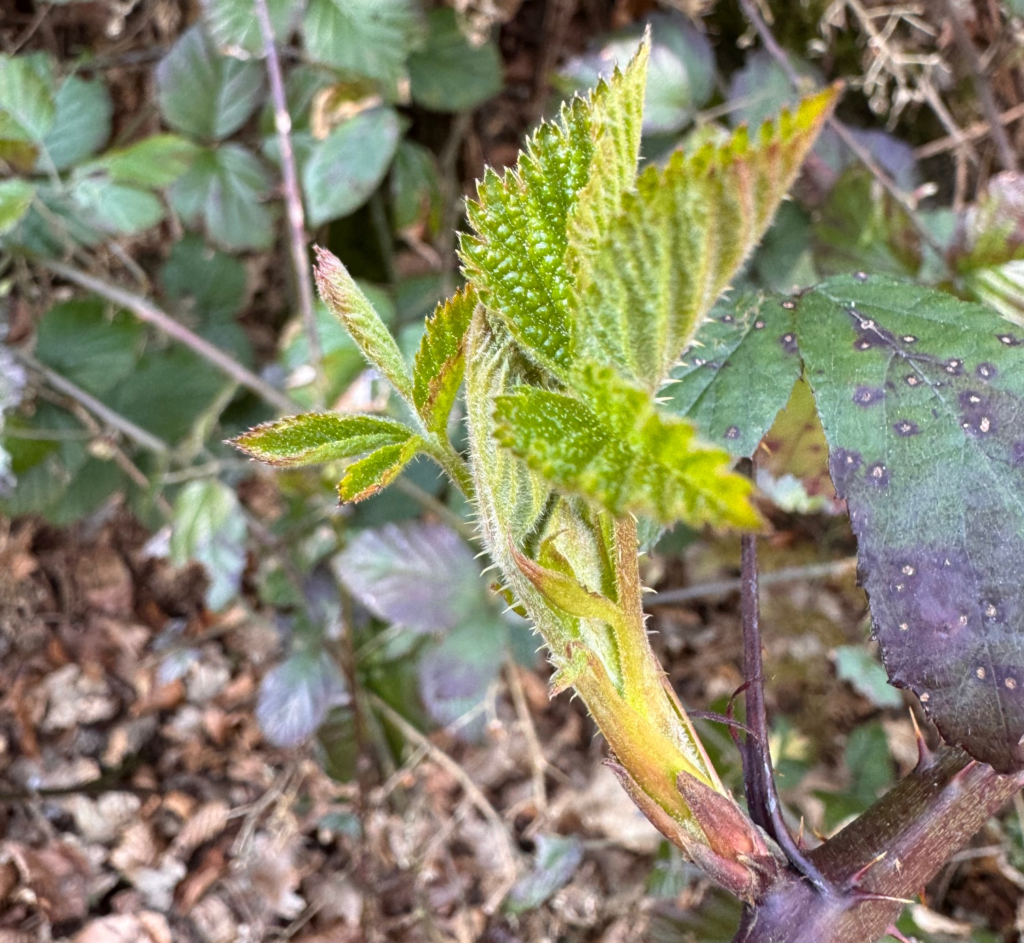
Identification: Arching stems armed with thorns, leaves serrated and strong
Habitat: Hedgerows, woodland edges
Uses: Leaves brewed into tea for a wet cough
Forage: Young leaves in spring
Folklore: A boundary plant, protective and enduring
Raspberry
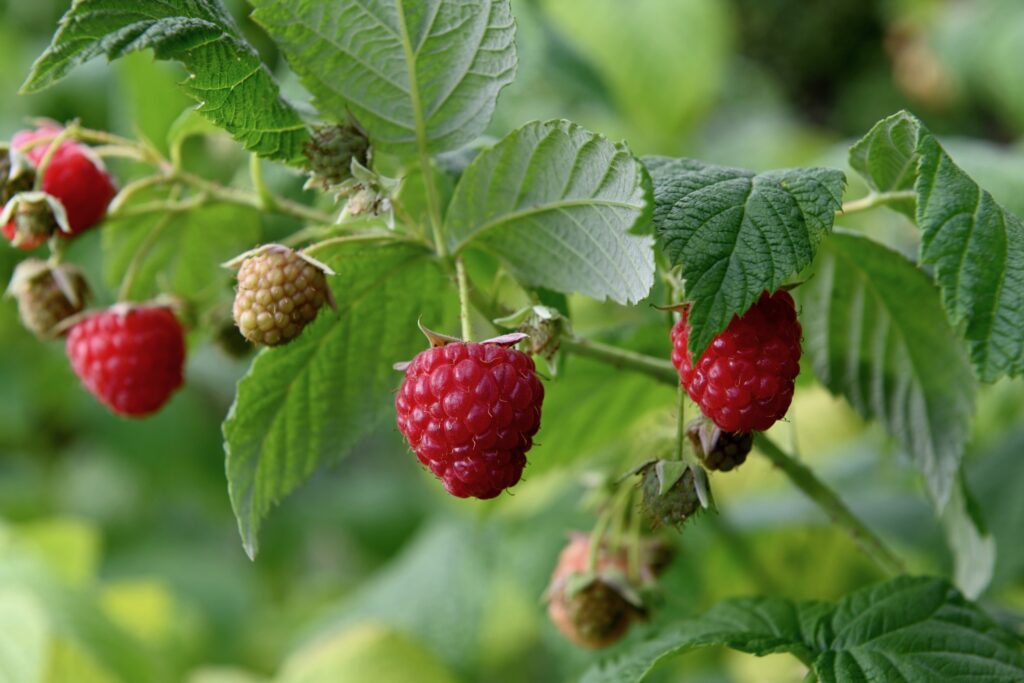
Identification: Soft stems, leaves pale beneath, textured and light, red thorns
Habitat: Woodland clearings, edges
Uses: Leaves long used to support the uterus and prepare the body for birth, berries for food
Forage: Leaves before fruiting, fruit
Caution: Avoid in early pregnancy. Later use should be mindful, as it can stimulate contractions
Folklore: Fertility, nourishment, quiet strength
Hawthorn
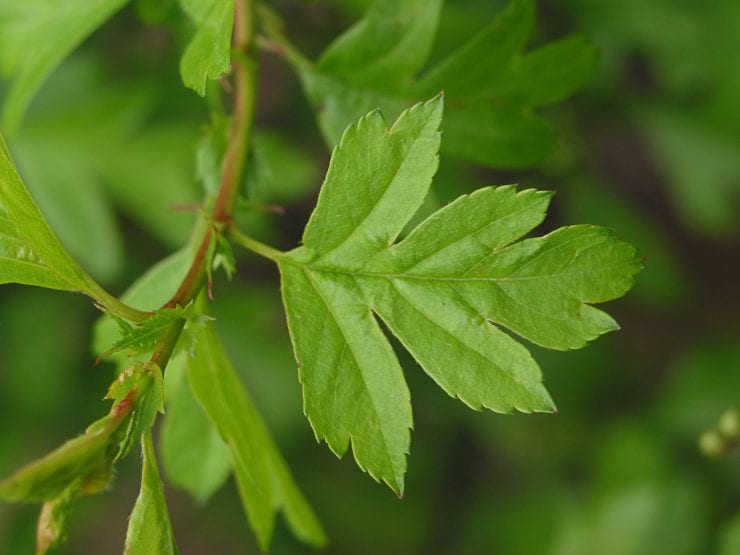
Identification: Small lobed leaves, guarded by thorns
Habitat: Hedgerows
Uses: Leaves and flowers taken as teas or tinctures to support the heart. Young leaves can be eaten fresh. Berries used to make tinctures as well as to make food, such as condiments and sweets
Forage: Spring leaves and blossom, autumn/winter berries
Folklore: Sacred to the heart. A tree of thresholds
Wood Aven (Geum urbanum)
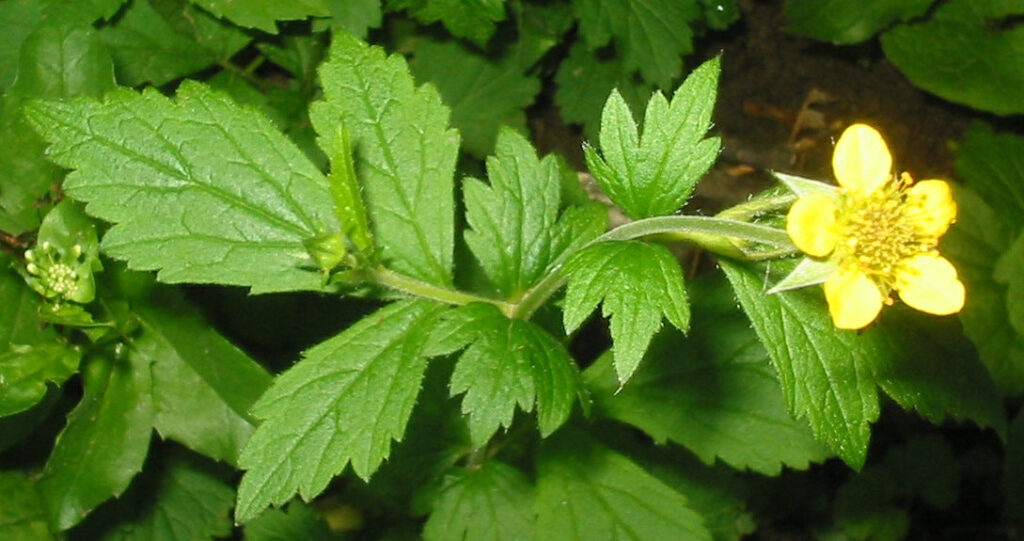
Identification: A quietly unassuming perennial, easy to overlook and worth getting to know. Leaves are divided and irregular, the lower ones pinnate — pairs of leaflets arranged along a central stalk like a feather — the upper ones simpler and three-lobed, all slightly hairy and toothed. The flowers are small, yellow, and five-petalled. The seed head that follows is the most reliable identifier — a rounded burr of hooked reddish bristles that cling readily to clothing and fur, one of nature’s most effective dispersal mechanisms.
Habitat: Shaded and semi-shaded ground — woodland edges, hedgerow bases, and disturbed ground where light filters through. A plant of the in-between places, neither deep shade nor full sun.
Uses: The root is the most medicinally useful part, containing eugenol, the same aromatic compound found in cloves, giving it a warm, spicy, clove-like scent and flavour. Washed and dried, the root can be used to flavour ale, wine, and broths, and was historically used as a spice before cloves became widely available. Medicinally it has a traditional use as a digestive bitter and mild antiseptic, and the root can be infused into honey or tincture for digestive support.
Forage: The roots are best foraged in mid-spring before the plant flowers, when the energy is still held below ground, or in autumn after the plant has died back. Always seek permission before foraging roots, as harvesting them kills the plant — a greater responsibility than picking leaves or flowers, and one that should never be taken lightly.
Folklore: Protection, warding, the holy herb.
Nettle Family (Urticaceae)
Nettle
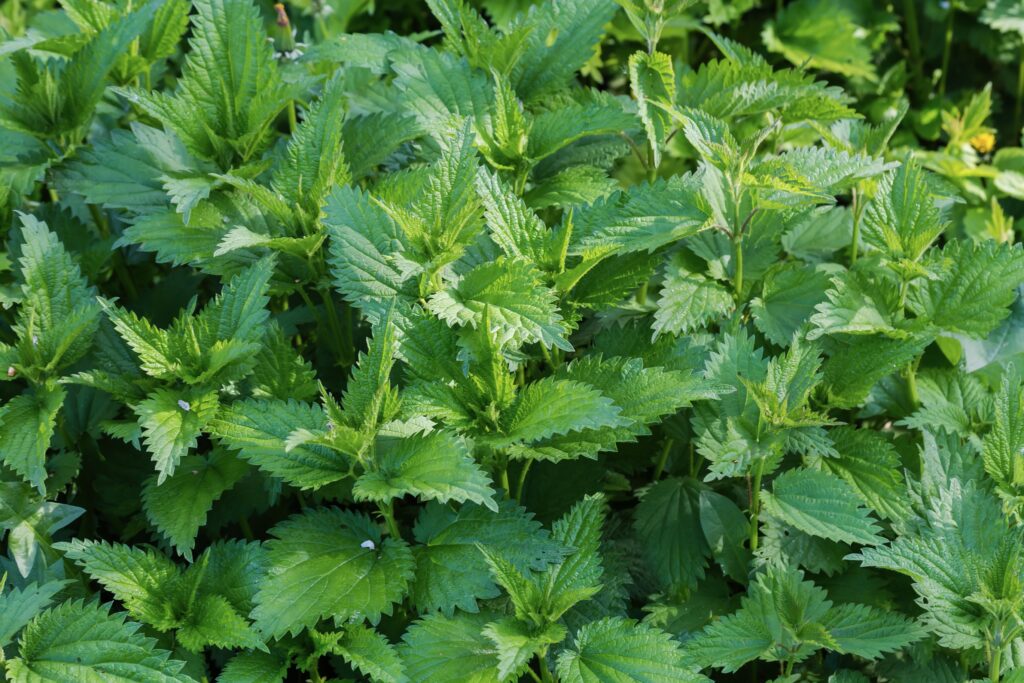
Identification: Bright green, serrated leaves carrying their sting
Habitat: Rich soils, places of abundance
Uses: Deeply nourishing and mineral-rich, offering iron, calcium, magnesium, vitamin C, and even a notable protein content. The young leaves (top 4–6 before the plant flowers) can be used much like spinach, added to dishes or even to naturally colour cakes. Fresh leaves may also be used for urtication—a traditional practice of gently stinging the skin to support circulation and ease inflammation in conditions such as arthritis or sprains. The seeds are highly nutritive, providing essential fatty acids, protein, and minerals. Roots, typically harvested in autumn, are often made into tinctures and have a long history of use in supporting prostate health. The stems can also be processed into a strong, durable fibre, suitable for cordage and rope-making.
Forage: Only the top four leaves, while still young and tender. Seeds can be foraged later in the season. Female plants produce the seeds, while male plants carry pollen-producing flowers that may resemble seed clusters
Folklore: Strength, protection, resilience
Coffee Family (Rubiaceae)
Cleavers
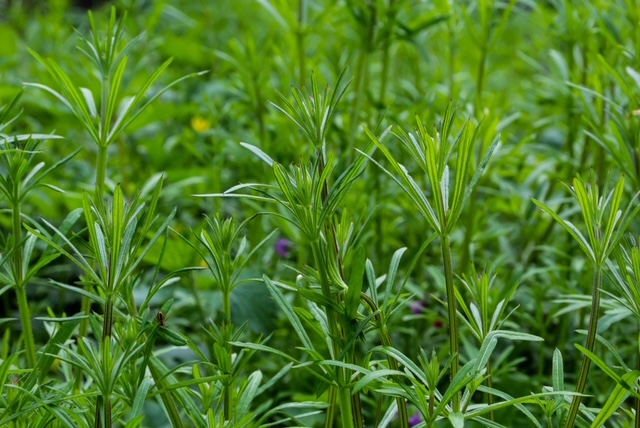
Identification: A plant that clings. Square stems, whorled leaves, soft hooks that catch on clothing and skin
Habitat: Hedgerows, woodland edges
Uses: Cooling and cleansing. Taken as tea or infused into water overnight, which has a light, fresh taste similar to cucumber water. Later, the seeds can be roasted and ground as a simple coffee. Treatment of diuretic disorders, lymph systems and as a detoxifier
Forage: Whole plant when young. Once it seeds, gather only the seeds
Folklore: A plant of connection
Borage Family (Boraginaceae)
Comfrey (Symphytum officinale) — “Knitbone”
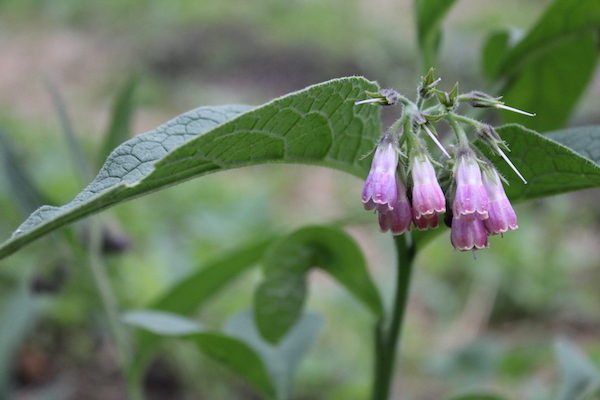
Identification: A robust, hairy perennial growing in a dense clump from the base. The leaves are large, rough, and lance-shaped, with stiff hairs that give them a noticeably coarse texture to the touch. Thick, slightly arching stems carry clusters of nodding, bell-shaped flowers ranging from creamy yellow through pink and purple to deep violet.
A note of caution — comfrey and foxglove: Comfrey leaves can be confused with foxglove, and both appear at similar times of year. Look closely at the leaf surface: foxglove leaves are soft and hairy, while comfrey’s hairs are noticeably stiffer and rougher. Running a finger gently across the leaf is often the quickest way to tell them apart. As foxglove is toxic, it is worth being certain before harvesting.
Habitat: Common along riverbanks, damp meadows, ditches, woodland edges, and hedgerows, favouring moist, nutrient-rich soils where it can form dense, abundant patches.
Uses: A plant long respected in traditional herbal practice. Comfrey is most renowned for its external use in supporting the healing of bruises, sprains, and minor fractures—hence its nickname “knitbone.” It has been used in poultices, salves, and infused oils to help soothe inflammation, encourage tissue repair, and support skin healing. In the garden, it is also valued as a dynamic accumulator, enriching compost and liquid feeds.
Forage: Leaves are sometimes used externally in preparations; internal use is generally avoided in modern herbalism due to safety concerns.
Folklore: Healing, resilience, bone-knitting.
Important Note: While historically used internally, comfrey contains pyrrolizidine alkaloids, which can be harmful to the liver if ingested. It is best reserved for external applications only, and even then used with awareness and moderation.
Geranium Family (Geraniaceae)
Herb Robert
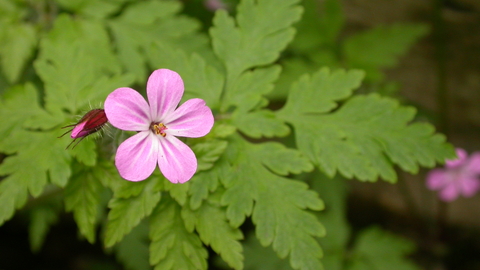
Identification: A delicate, low-growing plant with deeply divided, fern-like leaves on slender reddish stems that often flush deeper red as the season progresses. The small, five-petalled flowers are a vivid pink-magenta, appearing from spring through to autumn. The most reliable identifier is the scent — strong, musky, and unmistakably foxy when the leaves are brushed or crushed.
Habitat: It favours shady, disturbed ground, walls, hedgerows, and the edges of woodland paths.
Uses: The fresh leaves can be rubbed directly onto the skin as a natural insect repellent — the strong musky scent that we might find arresting is apparently far less welcome to mosquitoes and midges. It is a simple and immediate use, requiring nothing more than a leaf picked and crushed between the fingers. Young leaves and flowers can also be added to salads, though sparingly — the flavour carries that same distinctive pungency, so a little goes a long way. They are best used as you might use a herb rather than a leaf, tucked among milder greens to add an interesting, slightly bitter note.
Forage: Leaves and flowers
Folklore: Mischief, protection, good fortune.
Plantain Family (Plantaginaceae)
Broadleaf Plantain
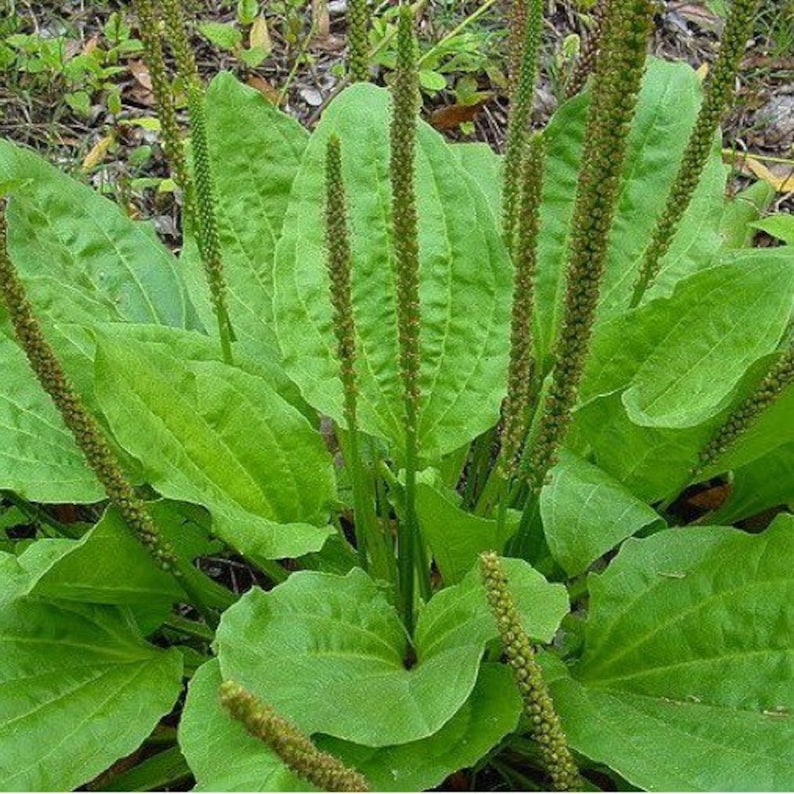
Identification: A low-growing perennial found almost everywhere humans have disturbed the ground — lawns, paths, roadsides, and compacted soil. The leaves are broad, oval, and distinctly ribbed with five to seven parallel veins running their full length, forming a flat rosette close to the ground. The flower is a slender, unremarkable spike rising on a long stalk, covered in tiny cream-coloured flowers and later small seeds. It is one of those plants hiding in plain sight — once you know it, you will find it absolutely everywhere underfoot.
Habitat: Paths, compacted earth
Uses: A remarkable first aid herb hiding in plain sight. The fresh leaf can be crushed or chewed and applied directly to insect bites, stings, and small wounds, offering quick, soothing relief through its anti-inflammatory and drawing properties. Internally, broadleaf plantain has a particular affinity with mucous membranes, making it a gentle and effective herb for soothing and healing an irritated or inflamed gut lining.
Forage: Young leaves
Folklore: A companion to travellers
Ribwort Plantain

Identification: Similar to its broadleaf cousin but altogether more upright and slender. The leaves are narrow and lance-shaped, standing erect rather than lying flat, with the same distinctive parallel ribbing running their length. The flower spike is tall and slim, topped with a compact, dark oval head ringed with a halo of pale cream stamens — distinctive and easy to spot once known.
Habitat: It favours meadows, grassland, and roadside verges, often growing in abundance where the ground is well drained.
Uses: A quietly powerful herb with a particular affinity for the respiratory tract, where it acts as an antimicrobial and anti-inflammatory, useful for coughs, catarrh, and bronchial irritation. Like broadleaf plantain it soothes mucous membranes, making it valuable for both the lungs and the gut lining. The fresh leaf can be applied to bites, stings, and minor wounds for quick relief.
The plant also offers a small culinary delight — the unopened flower buds, picked before the stem fully elongates, carry a surprisingly deep, earthy flavour of mushroom. They can be eaten raw, added to salads, or lightly cooked, and never fail to surprise people on a foraging walk.
Forage: Leaves and buds
Folklore: Endurance
Adoxaceae Family
Elder
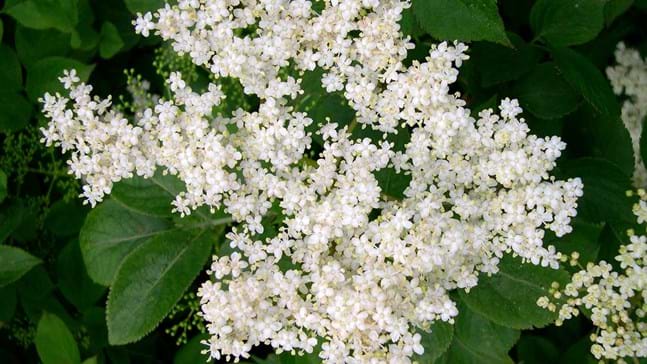
Identification: A shrub or small tree with opposite leaves arranged in pairs along the stem, each leaf divided into several pointed leaflets with a slightly serrated edge. Rub a leaf between your fingers and the scent is unmistakable — a curious, unpleasant smell often likened to burnt rubber or stale coffee, which makes it one of the more surprising identifiers in the hedgerow. In early summer the plant is laden with large, flat-topped clusters of tiny, creamy white flowers with a heady, sweet, unmistakably floral fragrance — a smell that could not be more different from the leaf. The contrast between the two is itself a useful reminder that you have the right plant.
Habitat: Elder is a true opportunist, thriving wherever the ground has been disturbed and nutrients are rich. It favours hedgerows, woodland edges, riverbanks, and waste ground, and has a particular affinity for soil high in nitrogen — which is why it so often appears near old buildings, compost heaps, rabbit warrens, and badger setts. It is rarely found in open, exposed landscapes, preferring the shelter of other vegetation to lean against and grow through.
Uses: The flowers are perhaps the most beloved of all hedgerow harvests, gathered in early summer and steeped to make cordials, elderflower champagne, or infused into syrups and vinegars. They are best picked on a dry, sunny day when their fragrance is at its fullest. Later in the year the berries follow, deep purple-black and heavy on the stem, rich in vitamin C and antioxidants. They make exceptional syrups, wines, and rob, which is a traditional concentrated berry syrup long used as a winter remedy for colds and immune support. The berries should always be cooked before consuming as raw elderberries can cause nausea.
Forage: Flowers in late spring, berries later in the year
Folklore: A tree to approach with respect. Always ask before taking
Mallow Family (Malvaceae)
Linden (Lime Tree)
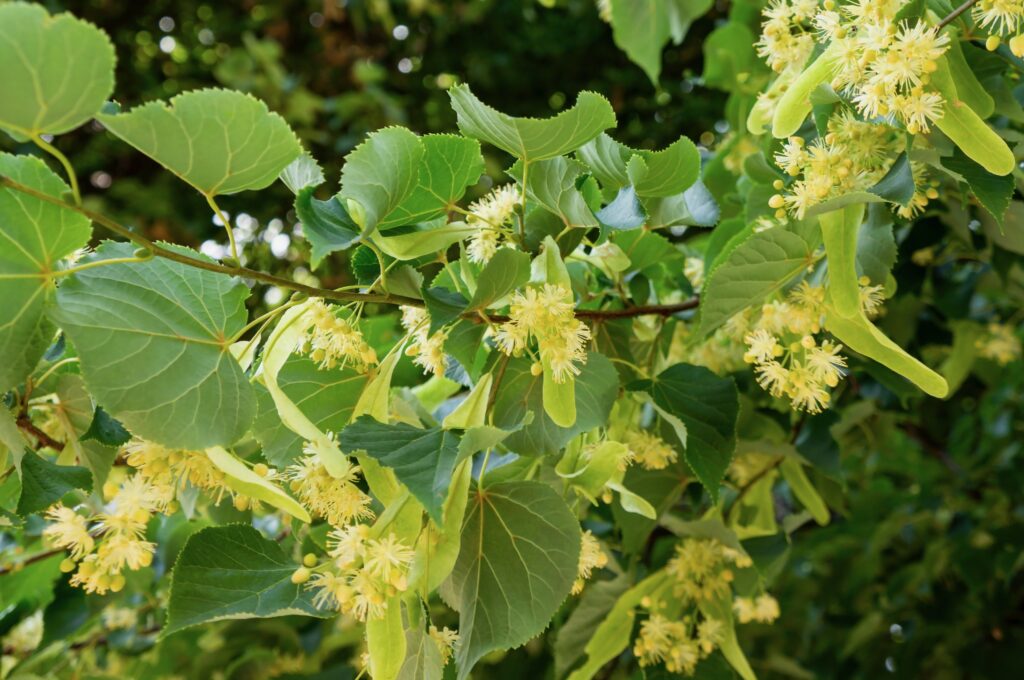
Identification: A tall, graceful deciduous tree with heart-shaped leaves, slightly asymmetrical at the base, with a pointed tip and finely toothed edges. The upper surface is smooth and mid-green, the underside paler with small tufts of hair in the vein axils. The flowers are small, creamy yellow, and delicately fragrant, appearing in midsummer in hanging clusters attached to a distinctive long, pale, tongue-shaped bract that acts like a wing, carrying the seeds on the wind once they ripen. It is this bract that makes linden unmistakable, no other common British tree has anything quite like it. The bark of mature trees is grey and furrowed.
Habitat: Linden is commonly found in parks, avenues, churchyards, and woodland edges, and in summer its flowers fill the surrounding air with a soft, honeyed scent that draws bees in extraordinary numbers.
Uses: In early spring the young leaves emerge soft, mild, and entirely edible, one of the more overlooked wild foods, pleasant eaten straight from the tree or added to salads. As the season progresses the leaves toughen and are better left. In midsummer the flowers are the prize, gathered at their peak and dried for tea, or steeped fresh into cordials much as elderflower is used. Linden flower tea has a long tradition as a calming, gently sedative drink, used across Europe for anxiety, restlessness, and sleeplessness. The flavour is delicate, sweet, and faintly honeyed — one of the most pleasant of all herbal teas.
Forage: Leaves in spring, flowers in early summer
Folklore: Love, softness, gentle protection
Daisy Family (Asteraceae)
One of the largest and most successful plant families in the world, the Asteraceae — or daisy family — is found on every continent and in almost every habitat. What looks like a single flower is in fact a composite of many tiny individual flowers packed together: the central disc florets surrounded by the outer ray florets that we recognise as petals. This clever architecture is one of the family’s great evolutionary successes, making it highly attractive to pollinators.
The family includes an enormous range of plants, from the humble lawn daisy and dandelion to chamomile, yarrow, mugwort, feverfew, echinacea, calendula, and sunflower. Many are significant medicinal herbs, and several appear regularly on the foraging walk today.
A note on allergy The daisy family is one of the most common causes of plant-related allergic reaction, known as Asteraceae or compositae sensitivity. Those who react to one member of the family — ragweed being a common trigger — may find they react to others, including chamomile, calendula, and echinacea. Reactions can range from mild skin irritation on contact to hay fever-like symptoms. If you know you have a sensitivity to any plant in this family, it is worth approaching all Asteraceae with a little caution, both topically and internally.
Dandelion
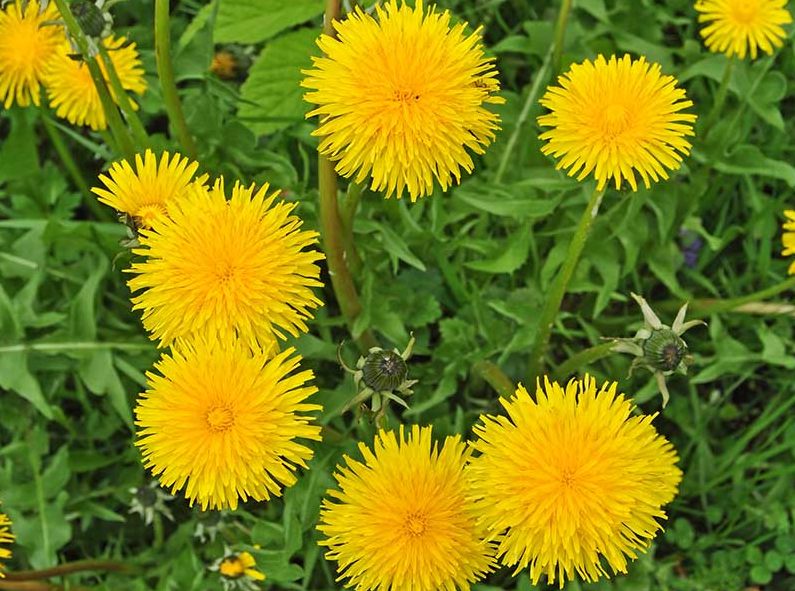
Identification: One of the most familiar and recognisable plants in the British landscape, and yet worth knowing well. The leaves grow in a flat rosette directly from the ground, deeply toothed and lobed in a pattern that gives the plant its name — dent de lion, the tooth of the lion. They are hairless and glossy, and when broken release a milky white sap. The flower is a single, bright golden yellow head on a hollow, unbranched stem, also releasing milky sap when cut. The seed head that follows is the perfect sphere of white, feathery clocks that children have been blowing for centuries.
A useful identifier is that everything about the dandelion grows directly from the base — there are no true stems with leaves branching off them, which helps distinguish it from similar yellow-flowered plants. The hollow flower stem and milky sap together are reliable confirmation.
Habitat: Dandelion is one of the great opportunists of the plant world, growing wherever it can find light and a foothold — lawns, meadows, roadsides, hedgerows, waste ground, cracks in pavements, and cultivated gardens. It is particularly associated with disturbed and nutrient-rich soil, and thrives in the kind of ground that humans create and then neglect. Found across virtually every habitat in Britain at some point, it is at its most abundant in open, grassy places where it can spread its seed clock freely on the wind. Its deep taproot allows it to survive compaction, drought, and repeated cutting, which is why it persists so stubbornly in lawns and managed grassland.
Uses: One of the most useful plants on the foraging walk. The leaves are a well-regarded diuretic, supporting the flow of water through the body and gently encouraging the liver and kidneys in their work — and unlike pharmaceutical diuretics, dandelion leaf replenishes the potassium lost in the process. In spring, when the leaves are young and at their least bitter, they make a nutritious and pleasantly peppery addition to salads. The flowers can be added to salads too, bringing a splash of gold and a faintly sweet, honeyed flavour.
The hollow stem has a quietly delightful practical use — it makes a perfectly functional drinking straw, a small wild magic that children particularly love.
The flowers can also be infused into oil, which has a long tradition of use on dry, irritated, or eczema-prone skin, offering gentle anti-inflammatory and soothing properties.
The roots offer perhaps the most surprising use of all. Washed, chopped, dried, and roasted, they produce a rich, dark tea with a flavour remarkably close to coffee — earthy, slightly bitter, and deeply satisfying. Caffeine-free and kind to the liver, it is one of the finest wild substitutes for coffee the hedgerow has to offer.
Forage: Leaves in spring, flowers and stems in season from early to mid-spring, roots best in early spring or autumn. As with all root foraging, always seek permission before harvesting, as removing the root kills the plant.
Folklore: Wishes carried on the wind
Yarrow (Achillea millefolium)
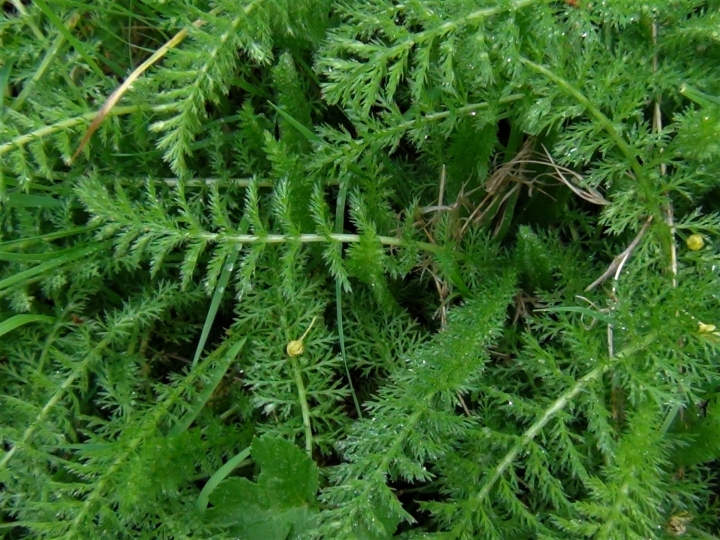
Identification: A common and distinctive perennial of meadows, roadsides, and grassland, yarrow is recognisable by its finely divided, feathery leaves — almost fern-like in their delicacy, soft to the touch, and strongly aromatic when crushed, with a sharp, medicinal, slightly bitter scent. The leaves grow alternately up a tough, angular stem that feels almost woody at the base. In summer the plant sends up flat-topped clusters of tiny flowers, typically white though occasionally pale pink, each cluster made up of many individual flower heads packed tightly together in the characteristic Asteraceae composite form. The overall impression is of a plant that is both delicate and robust — fine-leaved and soft, yet growing firmly and persistently in some of the most exposed and trampled ground around.
Habitat: Yarrow is a plant of open, well-drained ground — meadows, grassland, roadsides, hedgerow banks, and coastal clifftops. It tolerates poor, dry soil remarkably well and is often found in the kind of exposed, sun-baked spots where other plants struggle. It spreads readily by both seed and creeping rhizome, forming loose colonies that return year after year. In managed grassland it persists despite regular cutting, its low rosette of feathery leaves surviving the mower and re-emerging reliably. A tough, sun-loving plant that asks very little of the ground it grows in.
Uses: One of the great first aid herbs of the hedgerow, with a long and well-earned reputation for staunching bleeding — its Latin name Achillea millefolium refers to the legend that Achilles used it to treat his soldiers’ wounds on the battlefield. A fresh leaf crushed and pressed to a cut or graze will help slow bleeding and reduce inflammation almost immediately.
Yarrow is also a bitter digestive tonic, stimulating the production of bile and digestive secretions, and has a traditional use for supporting the liver and circulation. It is a reliable herb for that depleted, sluggish feeling that comes with seasonal transition.
The leaves and flowers can be infused in oil and made into a balm — a beautiful and practical first aid preparation to keep at home, useful for cuts, grazes, bruised or inflamed skin, and general wound healing.
Pregnancy: Avoid in medicinal quantities during pregnancy. A traditional emmenagogue with a long history of use to stimulate menstrual flow. Small amounts as a culinary herb are generally considered low risk, but it is worth flagging.
Name Meaning: Achillea, named for Achilles; millefolium for “thousand leaves,” referring to the plant’s finely divided, feathery foliage.
Folklore: War, love, divination.
Yarrow is one of the oldest known medicinal plants — pollen has been found in Neanderthal burial sites, suggesting a relationship with humans stretching back at least 60,000 years. On the battlefield it was known as Soldier’s Woundwort, Knight’s Milfoil, and Herbe Militaire, pressed into wounds across centuries of European warfare. In matters of the heart it was equally trusted — tucked under a pillow it was said to bring dreams of a future lover, and in parts of Britain young women would hold a leaf to their eye and recite a charm to conjure the face of their beloved. The Chinese I Ching, one of the oldest divination systems in the world, traditionally uses dried yarrow stalks to cast its readings — a use that speaks to the plant’s perceived connection to wisdom, clarity, and the unseen.
Mugwort (Artemisia vulgaris)
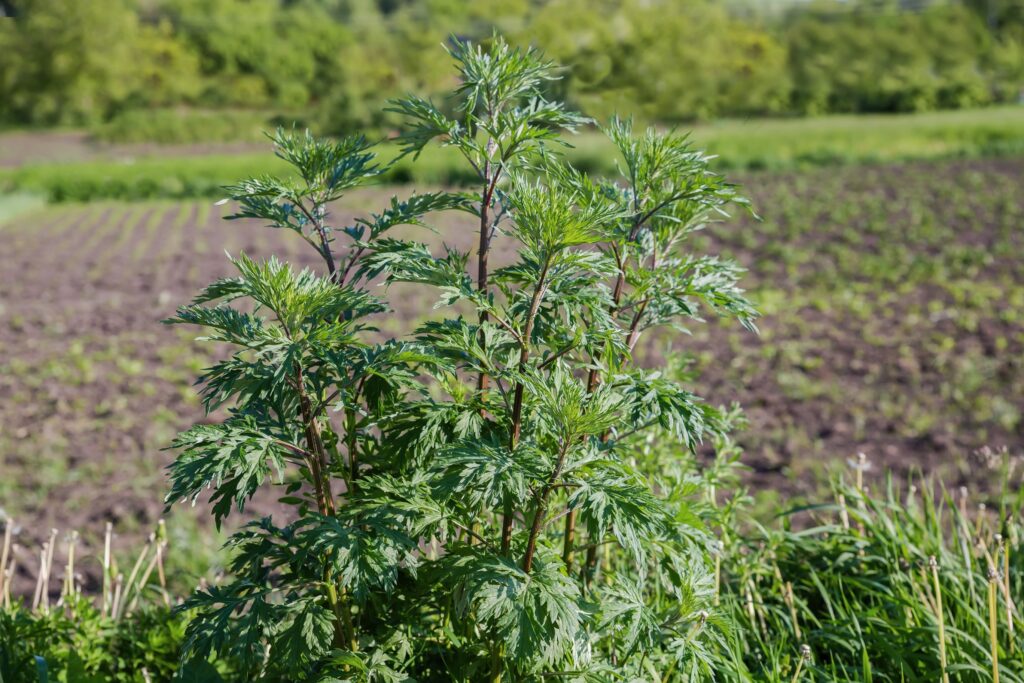
Identification: A tall, vigorous perennial of roadsides, riverbanks, and waste ground, mugwort can reach well over a metre in height and has a distinctly architectural presence in the landscape. The leaves are deeply divided and lobed, dark green on the upper surface and strikingly silver-white and downy underneath. Turn a leaf over and the contrast is immediate and beautiful. The stems are reddish-purple, angular, and slightly woody at the base. The flowers are small, oval, and unremarkable, tiny reddish-brown or yellow buds arranged in long, branching spikes in late summer, but the plant needs no showy flower to announce itself. Crush a leaf and the scent is immediate and distinctive: aromatic, slightly bitter, and complex, with hints of sage and something wilder underneath. It is one of the more unmistakable scents in the hedgerow once known.
Habitat: Mugwort is a plant of disturbed, nitrogen-rich ground, thriving in the kind of places humans create and move through — roadsides, riverbanks, field margins, waste ground, railway embankments, and the edges of paths and tracks. It has a particular affinity for urban and semi-urban environments, growing with confidence in city margins and forgotten corners where other plants struggle to establish. It is rarely found in pristine woodland or undisturbed meadow, preferring instead the company of human activity and the fertile, unsettled soil that follows in its wake. A plant of boundaries and edges, in every sense.
Uses: Bitter and aromatic, mugwort works on two distinct planes: the digestive and the dreaming. As a bitter herb it stimulates digestive secretions and bile flow, supporting a sluggish gut and easing heaviness after eating. It has a long history of use for irregular or painful menstruation, and as a gentle nervine for anxiety and restlessness, though its contraindication in pregnancy is well established and important to note.
In traditional Chinese and Japanese medicine, mugwort is the herb used in moxibustion. The dried leaves, known as moxa, are burned close to or on acupuncture points to warm and stimulate the flow of qi through the body. It is one of the oldest therapeutic practices in the world, still widely used today.
In Japan, and particularly in Okinawa, mugwort, known as yomogi, is woven into daily life as both food and medicine. It flavours mochi and rice cakes, is eaten as a spring vegetable, and is used in baths, teas, and topical preparations. In Okinawa, long celebrated for the exceptional longevity of its people, yomogi is considered one of the everyday plants that quietly sustains a long and healthy life.
Mugwort is also traditionally associated with dreaming. Placed under a pillow or taken as a tea before sleep, it was said to bring vivid, lucid, and prophetic dreams.
Pregnancy: avoid during pregnancy. Contains compounds that stimulate uterine contractions and has a long history of use as an emmenagogue. This is the most important contraindication on the list and applies to both medicinal and larger culinary amounts.
Forage: Leaves before flowering, then flowers for teas, dream pillows, and moxa
Folklore: A plant of the threshold world, of intuition, dreams, and the unseen currents beneath ordinary perception
Common Daisy (Bellis perennis)
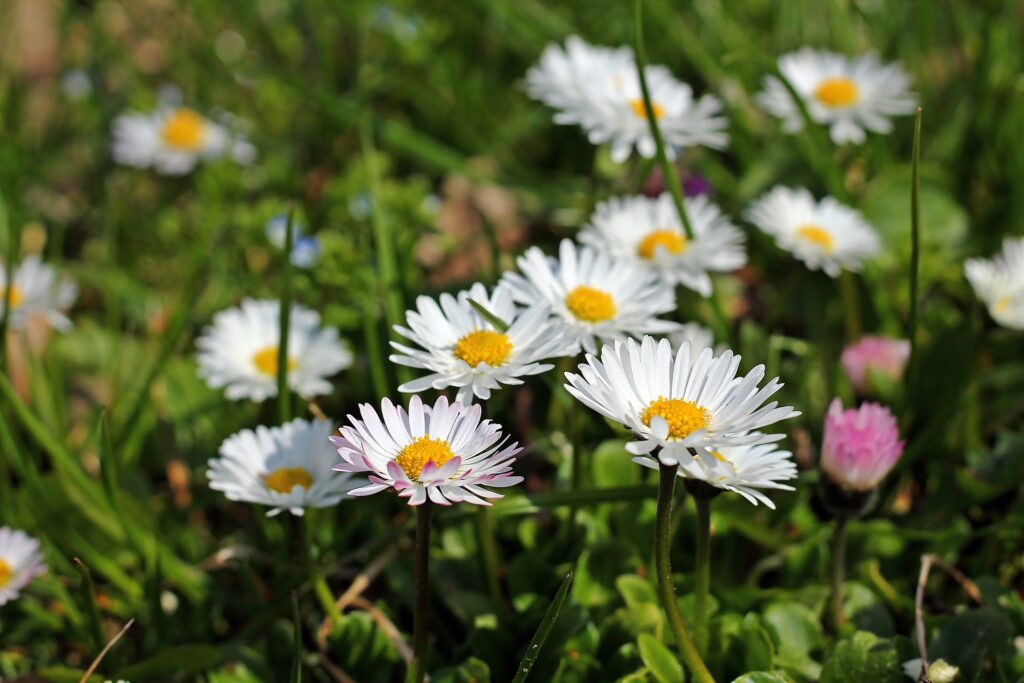
Identification: One of the most loved and familiar wildflowers in Britain, the common daisy is a small, low-growing perennial forming a flat rosette of spoon-shaped leaves close to the ground, slightly hairy and finely toothed at the edges. From this modest base rises a slender, leafless stem carrying a single flower head, the classic white ray florets surrounding a bright golden yellow disc, which closes at night and in cold or wet weather, a behaviour that gave rise to its name, from the Old English meaning eye of the day. It is one of the earliest flowers to appear in spring and one of the last to fade in autumn, a near constant presence in lawns and grassland throughout the growing season. Small, cheerful, and entirely unpretentious, a plant that asks nothing and gives a great deal.
Habitat: Grasslands, lawns, paths, places that are regularly walked.
Uses: Often called the arnica of the UK — a fitting title for such a common and accessible plant. The flowers can be infused into oil and made into a balm for bruising, swelling, and muscular soreness, offering a gentle anti-inflammatory action that makes it a valuable addition to any homemade first aid kit. It is a particularly useful alternative for those who react to arnica, which, as a fellow member of the daisy family, is not suitable for everyone. The flowers and young leaves can also be added to salads.
Forage: Flowers and young leaves
Folklore: A plant of simplicity and resilience, often associated with innocence, healing, and gentle joy. Its Latin, Bellis perennis, means “pretty” and “everlasting”.
Oxeye Daisy (Leucanthemum vulgare)
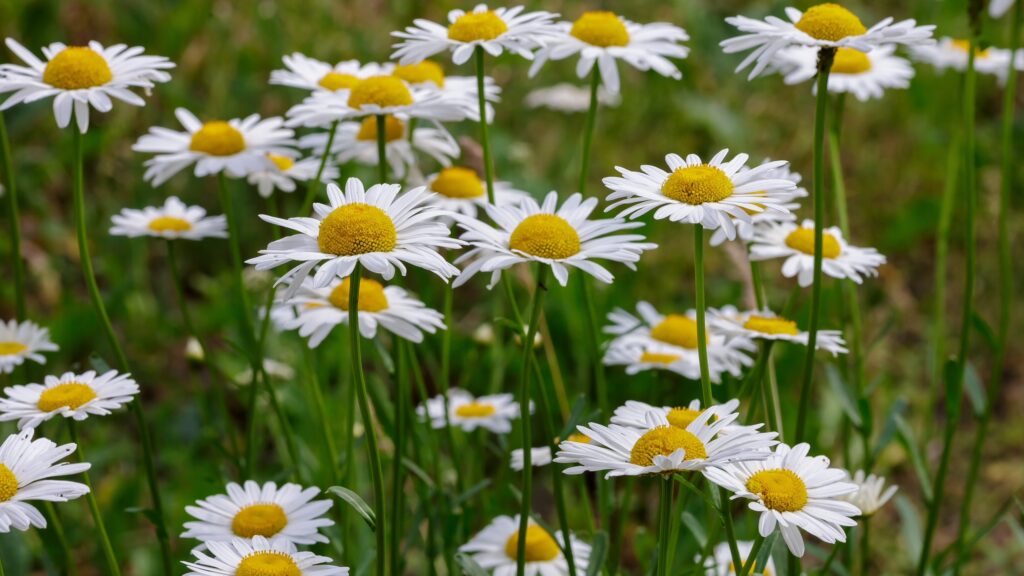
Identification: A taller, more striking relative of the common daisy, the oxeye daisy stands confidently upright in meadows and grassland, reaching up to 60 or 70 centimetres in height. The flowers are large and showy, with a broad, bright white ring of ray florets surrounding a flat, golden yellow discs. They are carried singly on long, slender stems that sway gently in the breeze. The leaves are dark green and slightly glossy, the lower ones spoon-shaped and long-stalked, the upper ones smaller, stalkless, and clasping the stem directly. It is a plant of unmistakable presence in a summer meadow, flowering from late spring through midsummer in drifts of white and gold that can stop you in your tracks.
Habitat: Oxeye daisy is a plant of open, well-drained grassland — meadows, roadside verges, chalk downland, and disturbed ground where it can establish freely. It thrives in poor, low-nutrient soil where coarser grasses and plants are kept in check, and is often one of the first wildflowers to colonise disturbed ground such as roadside cuttings and field margins. A lover of full sun and open skies.
Uses: The flowers are fully edible and make a beautiful addition to salads, their bold white and yellow heads bringing both colour and a mild, slightly bitter flavour. They are equally striking used as a natural decoration for food and drinks. The unopened buds are perhaps the most interesting culinary discovery — pickled in vinegar they make a convincing and elegant substitute for capers, with a similar briny, slightly sharp quality that works beautifully in dressings, pasta, and antipasti.
Forage: Buds and flowers
Folklore: Love, lightning protection.
Pea Family (Fabaceae)
Red Clover (Trifolium pratense)
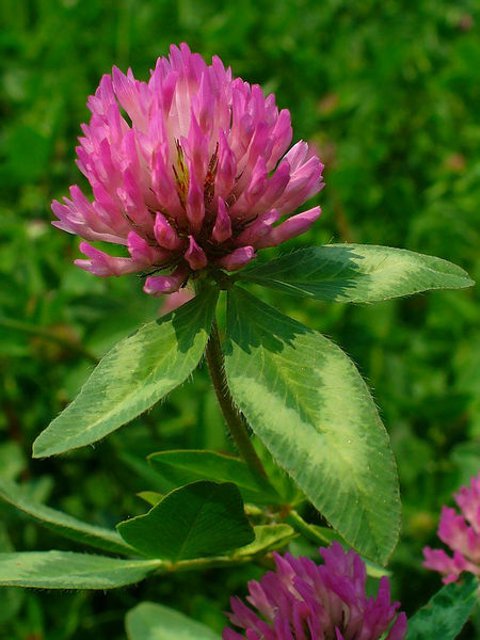
Identification: A familiar and cheerful perennial of meadows and grassland, red clover is recognisable by its rounded, deep pink-magenta flower heads — not truly red despite the name — sitting atop upright, softly hairy stems. The leaves are made up of three oval leaflets, each one typically marked with a pale, chevron-shaped watermark that is one of the most reliable identifiers of the species. The leaflets are slightly hairy on both surfaces. Flowers from late spring through summer and into autumn, offering a long and generous season of colour.
Habitat: It is a plant of open, sunny grassland, often found growing in abundance alongside grasses and other meadow flowers, where its vivid flower heads make it one of the easiest wildflowers to spot from a distance.
Uses: The flowers are the primary forage — fully edible and pleasantly sweet, they can be eaten straight from the plant, scattered into salads, or dried for tea. Red clover flower tea has a long tradition of use as a gentle remedy for coughs, bronchial congestion, and skin conditions. The flowers can also be added to baked goods or infused into honey.
Medicinally, red clover is best known for its isoflavone content — plant compounds with a mild oestrogenic action that have been widely studied for their role in supporting hormonal balance, particularly during the menopause, where they may help ease hot flushes and other symptoms. It is one of the more researched medicinal wildflowers in the hedgerow.
Ecologically it is enormously valuable — one of the most important nectar plants for bumblebees, whose long tongues are perfectly suited to reaching into the deep flower tubes. A single patch of red clover in full bloom is rarely without visitors.
Pregnancy: Avoid in medicinal quantities during pregnancy due to its phytoestrogen content.
Forage: Flowers
Folklore: Luck, protection, the fourth leaf.
Common Vetch (Vicia sativa)
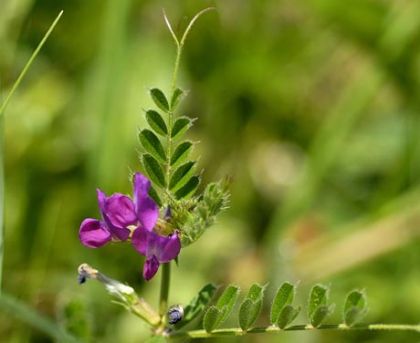
Identification: A slender, trailing or climbing plant that weaves itself through grasses, hedgerows, and scrub with the help of delicate tendrils at the tips of its leaves. The leaves are divided into several pairs of narrow, oblong leaflets, giving the plant a light, ladder-like appearance. The flowers are pea-like and small, typically a rich purple-pink though varying to paler pink or occasionally white depending on species, appearing in ones or twos from the leaf axils along the stem. It forms soft, scrambling tangles through other vegetation rather than standing upright on its own, easy to overlook until the vivid little flowers catch the eye. A delicate plant with a surprisingly firm grip.
Habitat: Common vetch is a plant of grassland, hedgerows, roadside verges, and field margins, favouring well-drained, often sandy or chalky soils in open, sunny positions. It is frequently found scrambling through long grass and along the bases of hedges, using neighbouring vegetation as support. Like all vetches it is a nitrogen-fixer, drawing nitrogen from the air and returning it to the soil through its roots, which makes it a quiet but valuable contributor to the health of the grassland communities it inhabits.
Uses: Ecologically, common vetch is a quietly generous plant. As a nitrogen-fixer it enriches the soil around it, benefiting neighbouring plants and contributing to the health of the wider grassland community. Its flowers are a valuable early nectar source for bumblebees and other pollinators, and the seeds are eaten by a range of birds and small mammals.
Culinarily, the young leaves, shoots, and tendrils can be eaten raw or lightly cooked in spring, when they are at their most tender — added to salads or wilted briefly like spinach. The seeds have a long history of use as a food source in times of scarcity, dried and ground into flour or cooked like lentils, though they should be eaten in moderation as large quantities can cause a condition called lathyrism with prolonged consumption. As a foraged food, the young green parts are the safest and most pleasant choice.
Pregnancy: Not a specific pregnancy contraindication as such, but the known risk of lathyrism from large quantities of seeds, combined with the general principle of caution during pregnancy, makes it sensible to avoid the seeds and limit consumption to small amounts of young leaves and shoots only.
Forage: Young shoots, tender leaves, and flowers (depending on species and identification certainty)
Important Note: Several species of vetch exist, and correct identification is important. Some varieties are grown as fodder crops and are not typically foraged. Always be certain of species before considering any use
Pink (Carnation) Family (Caryophyllaceae)
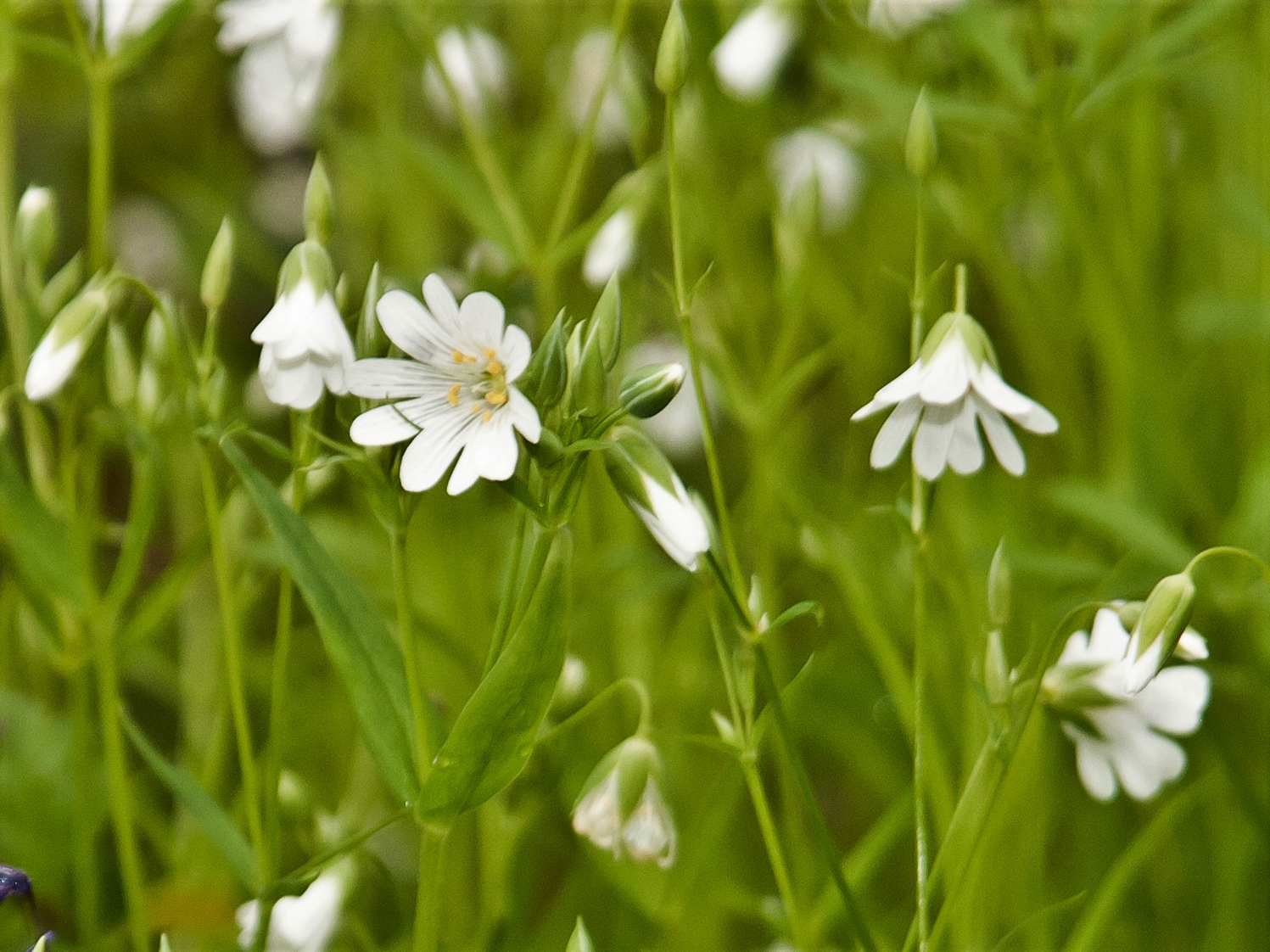
Stitchwort
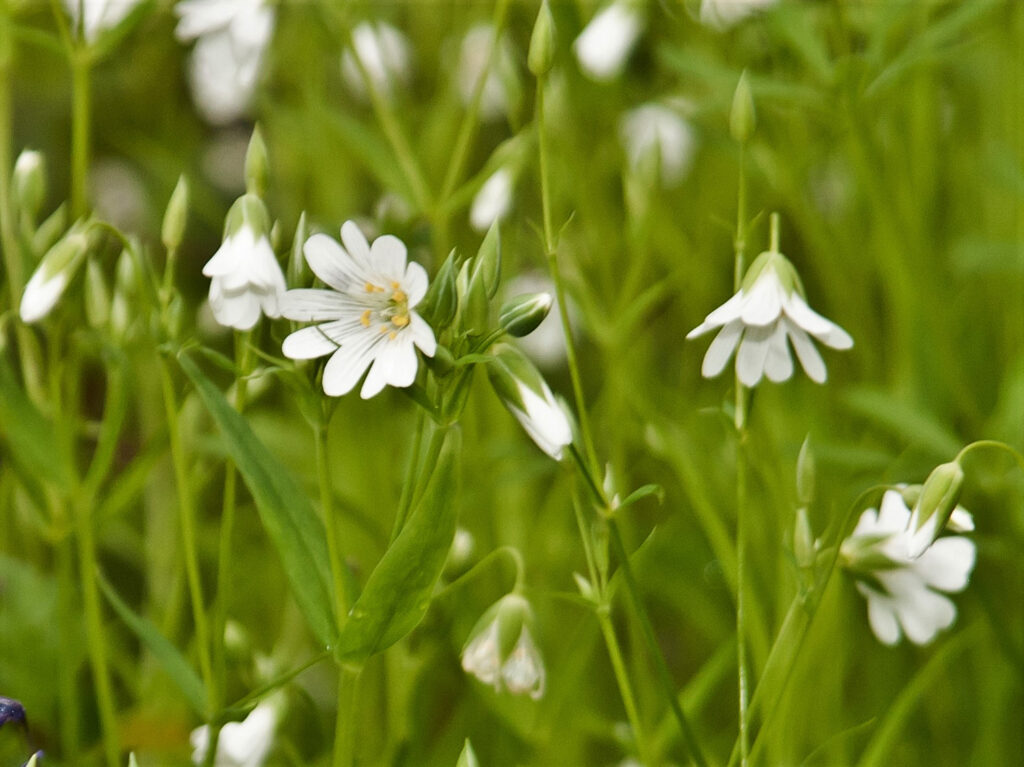
Identification: A delicate, straggling perennial, stitchwort has a fragile, airy quality that belies its persistence. The stems are weak and slightly rough to the touch, four-angled and brittle, leaning through and over neighbouring vegetation for support rather than standing alone. The leaves are narrow, lance-shaped, and unstalked, arranged in opposite pairs along the stem, pale to mid-green and slightly rough at the edges. The flowers are the plant’s great beauty — bright, pure white with five deeply notched petals, each so deeply cut that at first glance they appear to be ten, carried on slender stalks above the foliage. They appear in drifts along hedgerows from mid-spring through early summer, catching the light with a clarity that makes them look almost luminous against the green. A plant of quiet, delicate charm.
Habitat: Stitchwort is a plant of hedgerows, woodland edges, and shaded lane-sides, favouring the dappled, sheltered conditions where light filters through without being too harsh or exposed. It thrives in moderately fertile, well-drained soil and is frequently found scrambling through the base of hedges and along sunken paths and ancient trackways, often appearing in great drifts in spring alongside bluebells and red campion. It is a good indicator of an old hedgerow or ancient woodland edge, having a preference for undisturbed, established habitats over disturbed or cultivated ground.
Uses: The flowers can be scattered into salads, offering a brief moment of wild delicacy, bright, pure white and entirely edible, they bring beauty to a plate as much as flavour. Traditionally the plant gave its name to a folk remedy for the stitch, that sharp side pain felt during running, and was carried or worn as a charm against it. A modest plant with a modest gift, but a lovely one.
Forage: Flowers sparingly. Leave plenty for pollinators.
Folklore: Fairies, thunder, the stitch.
Wood Sorrel Family (Oxalidaceae)
Wood Sorrel (Oxalis acetosella)
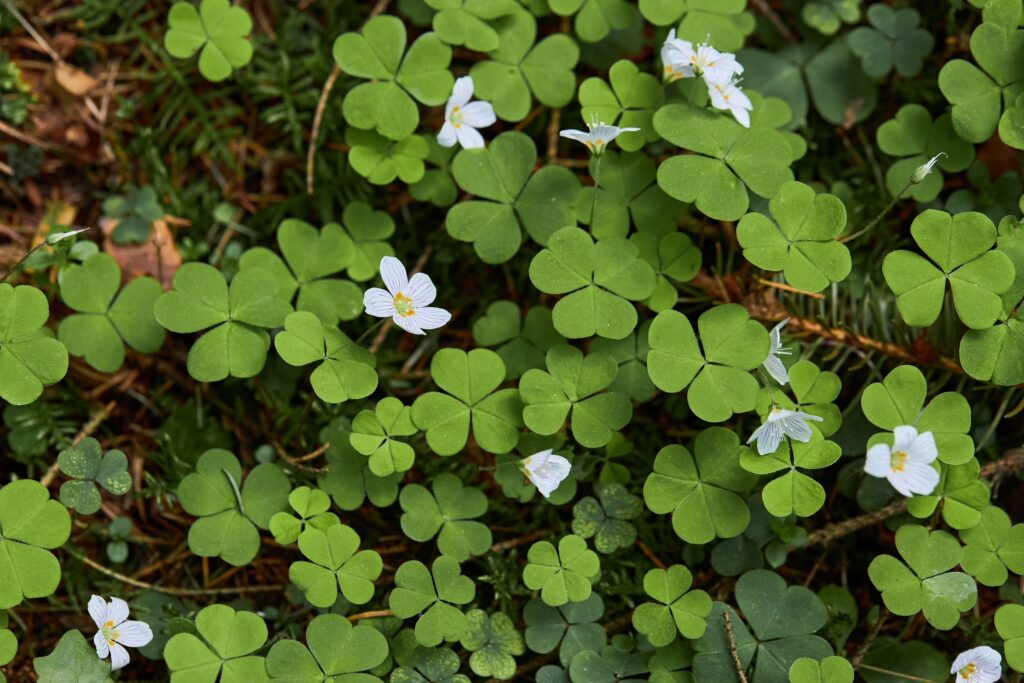
Identification: A delicate, low-growing perennial of shaded woodland floors, wood sorrel is one of the most charming plants of the spring forest. The leaves are made up of three heart-shaped leaflets, bright fresh green and folded along the midrib like tiny wings, closing at night and in bright sunlight in a behaviour known as nyctinasty. They grow on slender, pale stalks directly from the ground, forming soft carpets beneath trees. The flowers are small and five-petalled, white with delicate lilac veining, nodding gently on their stems.
Habitat: Wood sorrel is a plant of shaded woodland, particularly ancient and established woods where the canopy is dense and the floor undisturbed. It has a preference for cool, moist, acidic soils and is frequently found carpeting the ground beneath beech, oak, and conifer woodland, often growing on mossy banks, rotting logs, and the bases of old trees. Its presence is often taken as an indicator of ancient woodland — a quiet sign that the ground beneath your feet has been forested for a very long time.
Uses: The leaves and flowers are both edible and delicious, one of the great small pleasures of the woodland floor. The flavour is bright, sharp, and distinctly lemony, coming from the oxalic acid that gives the genus its name, and it brings a vivid freshness to salads, dressings, and cold dishes. It works beautifully as a garnish, its delicate heart-shaped leaves and white flowers as pretty on a plate as they are in the wood. The juice can be used as a substitute for lemon in dressings and sauces.
As with all plants high in oxalic acid, spinach and rhubarb share this quality, wood sorrel is best enjoyed in moderate amounts rather than in large quantities, and those with kidney stones or gout are advised to use it sparingly.
Forage: Spring leaves and flowers
Folklore: The true shamrock, luck, the trinity.
Pine Family (Pinaceae)
Scots Pine (Pinus sylvestris)
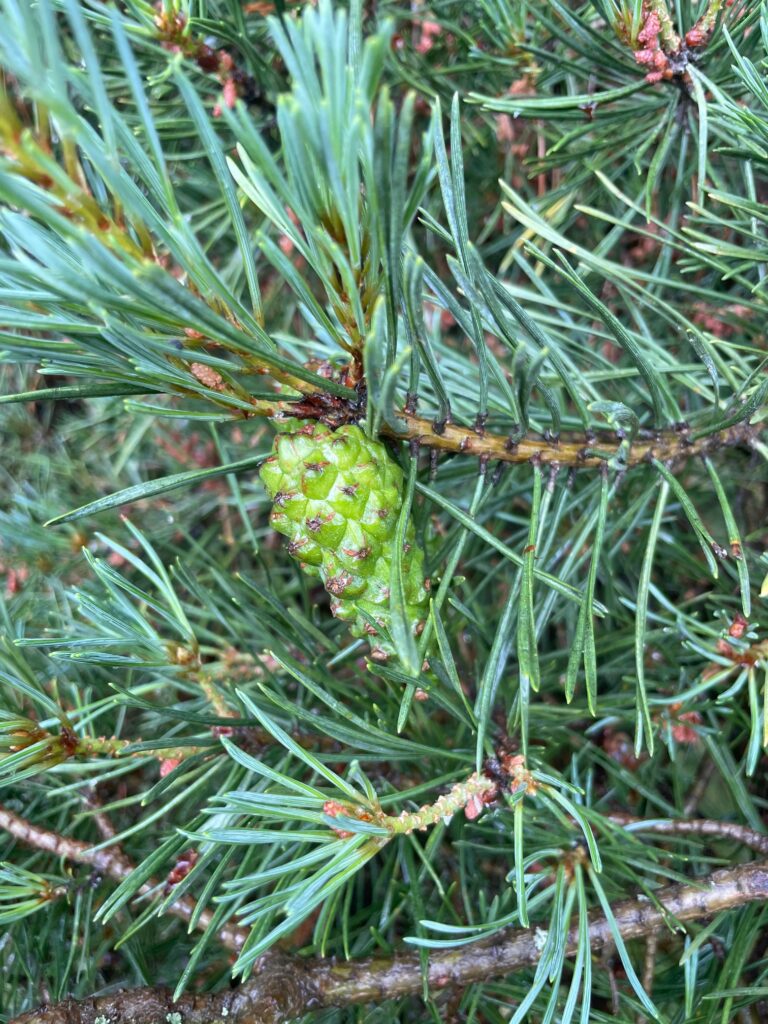
Identification: The only native pine in Britain, Scots pine is a distinctive and handsome tree with a character that becomes more striking with age. Young trees are broadly conical, but mature specimens develop a flat or domed crown, often leaning and asymmetrical, with the lower branches gradually lost to leave a tall, clear trunk. The bark is one of the most reliable identifiers — deeply furrowed and grey-brown at the base, becoming a warm, flaking orange-red higher up the trunk, particularly beautiful in low winter light. The leaves are needles, carried in pairs, blue-green and slightly twisted, around five to seven centimetres long. The cones are small, oval, and woody, taking two years to ripen from the small green buds to the familiar brown cone.
Habitat: Scots pine is native to the ancient Caledonian forests of Scotland, where it once covered vast areas of the Highland landscape and remnants of this ancient forest still survive. In England it is widely naturalised, particularly on sandy, acidic soils such as those of the Surrey Hills, the New Forest, and the Breckland of East Anglia, where it was extensively planted in the 18th and 19th centuries and has since spread freely by seed. It thrives in open, well-drained, nutrient-poor soils where it faces little competition from broadleaved trees, often forming open, airy woodland with a distinctive character — light-filled, resinous, and carpeted with heather, bilberry, and mosses beneath.
Uses: The needles (year round) are the most accessible forage, gathered year round and made into a tea that is high in vitamin C and pleasantly resinous — fresh and green in flavour, with a clean, piney warmth. The same needles can be fermented into a wild soda or simple fermented drink, using their natural yeasts and volatile oils to produce something lively and aromatic.
The young green cones (early summer, around June), gathered in early summer before they harden, can be made into a rich, dark syrup in two ways — simmered slowly with sugar or honey, or simply layered into a jar and covered with sugar, then left to sit while the moisture inside the cones slowly steeps out, drawing a deep, resinous syrup without any heat at all. Both methods produce something dark, fragrant, and medicinal, with a long tradition in Scandinavian and Eastern European folk medicine as a remedy for coughs, sore throats, and bronchial congestion.
The pollen (spring, around April), gathered in late spring by tapping the male catkins over a bowl, is rich in amino acids and antioxidants and can be added to smoothies, stirred into honey, or taken by the teaspoon. The harvest window is brief — catch it while you can.
Forage: Needles, pollen, and green pine cones
Folklore: Immortality, groundedness, the ancient witness.
A Gentle Reminder
Foraging is a relationship, not just a harvest.
Pause before you pick. Ask permission in whatever way feels meaningful to you. In doing so, you begin to meet the plant as a living being rather than a resource.
Over time, this becomes more intuitive. You start to sense whether there is enough, whether taking will disturb more than it gives, and whether the place is asking to be left untouched.
Only forage for yourself, unless you have permission from the landowner.
Follow the four Fs, and take only what you will truly use.
As a guide, take no more than one third, and often far less.
Leave enough for the insects, the animals, and for the continued life of the land. And always offer thanks. Happy foraging!

